![\[ f (x, y, z) = \sum_{0 \leqslant i \leqslant d_1, 0 \leqslant j \leqslant d_2, 0 \leqslant k \leqslant d_3} c_{i, j} B^i_{d_1} (x ; a, b) B^j_{d_2} (y ; c, d) B^k_{d_3} (z ; e, f) \]](form_461.png)
 , defined by two implicit equations
  ,
,  , where
 ![$f, g \in \mathbbm{R}[x, y]$](form_459.png) . It uses the representation of polynomials in the Bernstein basis of a domain
. It uses the representation of polynomials in the Bernstein basis of a domain ![$D = [a, b] \times [c, d] \times [e, f] \subset \mathbbm{R}^3$](form_460.png) :
:
where  is the Bernstein basis in degree
  , on the interval
 ![$[u, v]$](form_463.png) . The subdivision algorithm is also based on a criterion for detecting the regularity of the curve , in the domain
. The subdivision algorithm is also based on a criterion for detecting the regularity of the curve , in the domain  .
.
void topology::assign(point_graph<C> & g, MPol<T>& p1, MPol<T>& p2,
         TopSbdCurve3d<C> mth,
         C x0, C x1, C y0, C y1, C z0, C,z1);
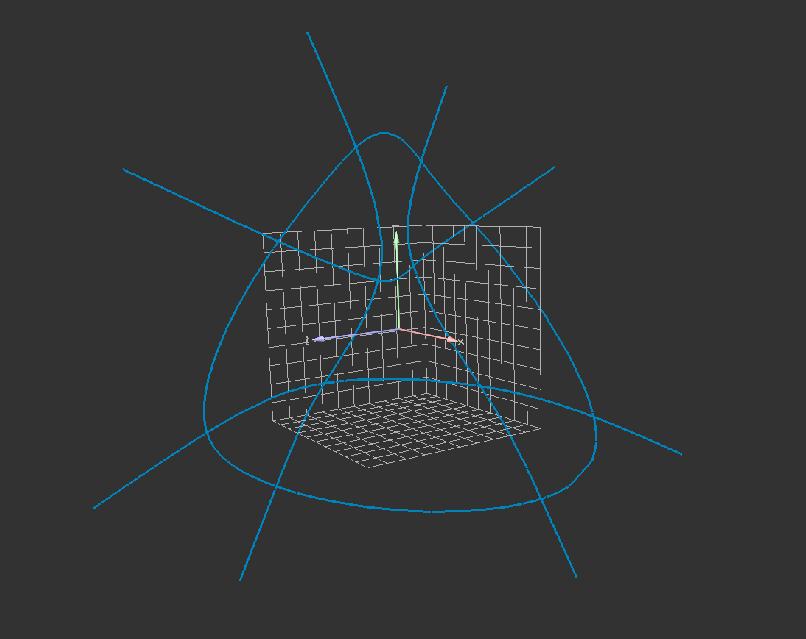
g of type topology::point_graph<C>, which is isotopic to the curve defined by the polynomial p1, p2, in the box . The coordinates of the points in g are of type C. The implementation is designed for C=double.p are of type T. During the computation, they are rounded to double number types. If the topology in the box can be certified from this approximation, a graph of points connecting the intersection of the curve with the boundary of  is computed. Otherwise the box is subdivided into
  subboxes and the test is applied recursively.
 specified by the class
 TopSbdCurbe3d<C>. The default value is  .
.synaps/topology/TopSbdCurve3d.h

#include <synaps/arithm/gmp.h>
#include <synaps/topology/TopSbdCurve3d.h>
#include <synaps/base/io/geomview.h>

int main(int argc, char** argv)
{
  MPol<double>
    p1("x^4+y^4+z^4-4*x^2-4*y^2*z^2-4*y^2-4*z^2*x^2-4*z^2-4*x^2*y^2+20.7846*x*y*z+1",
       Variables("x y z")),
    p2("4*x^3-8*x-8*x*z^2-8*x*y^2+20.7846*y*z", Variables("x y z"));

  topology::point_graph<double> g;
  topology::assign(g, p1,p2, TopSbdCurve3d<double>(),
                   -2.1,2.,-2.15,2.1,-2.1,2.2);

  geomview::ostream os("tmp.off");os<<g;os.view();

}
Here is a picture of the corresponding result:
 |